Alright, let’s cut to the chase—if you’re in automotive, appliance, or any high-volume metal assembly, you already know a flexible projection welding line isn’t just a hunk of metal and weld guns. It’s a well-oiled team, and the control system is its coach. I’m the owner of a welding equipment supply company, and I’ve sat across from enough production managers who’re confused about why their line won’t sync with their new ERP, or why a tech took 3 hours to tweak a weld parameter mid-run. 9 times out of 10, the issue boils down to the control system’s communication interface. Let’s break this down like we’re troubleshooting a line at 2 a.m.—no jargon fluff, just real talk. Flexible Projection Welding Line
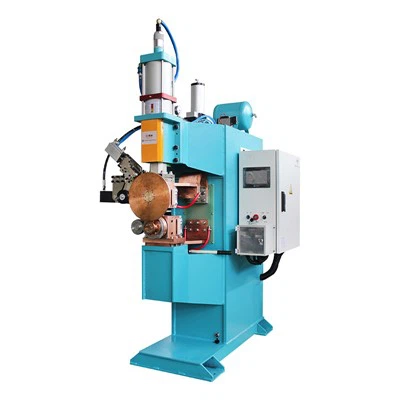
First, let’s get one thing straight: when people say “communication interface” for a flexible projection welding line’s control system, they don’t mean a random USB port for a mouse. This is the line’s entire back-and-forth with every other system it talks to. A flex line’s whole point is switching between 10 different part numbers in 15 minutes, not sitting idle while an operator manually loads new programs. So the interface isn’t just a wire—it’s the language the control system speaks, how it shares data, and how humans (or other machines) tap into that.
Let’s start with the most critical side: how the line talks to factory-level systems. If you’re a plant manager, you probably run ERP or MES (Manufacturing Execution System) to track parts, orders, and downtime. If your welding line can’t pull a part’s exact weld specs from MES on its own, you’re wasting 15 minutes per batch manually entering data. I see this all the time—old lines that use 90s-era fieldbus protocols (like DeviceNet) can’t talk to modern cloud-based MES, so you end up with mismatched weld counts or wrong parameters. The good flex lines we supply use two big protocols here: Ethernet/IP and PROFINET. These aren’t just tech buzzwords—Ethernet/IP is the go-to for US automakers, while PROFINET dominates European appliance lines. Why? They’re fast enough for a line that’s moving parts on a conveyor every 2 seconds, and they work with every MES out there now. No more custom coding to force data through a converter that slows everything down.
Wait, but what about the welding guns themselves? They don’t just get a signal from the main control box—they need real-time data, right? Like, if a weld gun’s tip is wearing down mid-run, the control system needs to know to adjust the current, or alert an operator before a bad part hits the next station. That’s where the field-level communication comes in. A lot of suppliers skip this, but it’s why our flex lines hold tolerance across 10,000 parts without a hitch. We use IO-Link for the smart sensors on the weld guns and clamps. It’s not a high-speed protocol like Ethernet/IP, but it’s perfect for small, frequent data—like tip wear, clamp pressure, or weld current. If you tried using PROFINET for this, you’d waste bandwidth and pay way more for hardware. Matching the protocol to the job is how we make flex lines actually flexible, not just expensive.
Now, the human side—because operators and maintenance techs can’t be left out. That’s the HMI (Human-Machine Interface), which is technically part of the communication interface too. I’ve walked into shops where the HMI is a tiny, scratchy screen with buttons that don’t light up, forcing operators to guess if a weld is good or not. Our lines have a 15-inch touch HMI that’s tailored to welding, not generic factory equipment. The interface here isn’t just tapping buttons—operators can pull up a part program in 2 clicks, adjust a weld current on the fly without logging into a separate laptop, and see real-time stats (like how many good parts, how many rejects) right on the screen. For maintenance techs, we build a diagnostic portal into the interface that shows exactly which weld gun is misfiring, and even what error code means in plain English (no “E-123: Comm Fault” garbage—just “Weld Gun 3 tip pressure too low, check air line”). That cuts downtime by 40% in most shops, from what our customers tell us.
Wait, what about when a line needs to talk to other automation? Like a robotic part loader? That’s another part of the interface. A lot of flex lines integrate with robots now, and the last thing you want is the robot and weld line crashing because they didn’t sync part positions. We set up the control system’s interface to send and receive part location data to the robot’s controller, usually via Modbus TCP if the robot isn’t a big brand, or the robot’s native protocol (like FANUC’s DeviceNet, but we make it work with Ethernet/IP too). The key here is that the interface has to be open, not proprietary. I turned down a big client last year because a supplier wanted to lock their control system to their own brand of robots—if that robot breaks, you’re stuck waiting 2 weeks for a part, not swapping in a robot from another brand. Our interfaces are open, so you can mix and match robots, sensors, and factory systems without being held hostage.
Let’s get real about common mistakes people make here. A few months back, a small appliance maker called us because their new flex line was taking 20 minutes to switch between washing machine tub parts. Turns out the supplier used a proprietary interface that only talked to their own MES, so they had to manually enter 80 parameters every time they switched a part. We swapped out the communication modules for Ethernet/IP and configured the line to pull the exact part specs from their existing MES, and cut changeover time by 85%. That’s the magic of the control system’s communication interface—it’s not a box on the back of the line, it’s what makes a flexible line actually flexible. Without a good one, you might as well run a bunch of standalone welders that can’t keep up with orders.
Another thing: data logging. If you’re in a regulated industry (like automotive or medical appliances), you need to track every weld—current, pressure, time—for every part, for years. The interface is what sends that data to your quality system. We build the control system’s interface to automatically log every weld and push it to your quality database, no extra software needed. No more operators writing down weld numbers on paper that get lost when a coffee spill hits the clipboard. That’s non-negotiable for most of our clients, and it’s all because the communication interface is set up to handle that data flow.
Wait, do we ever get asked about old lines? Sure. A lot of plants have legacy projection weld lines that work, but they can’t integrate with new systems. We can retrofit their control system’s communication interface without replacing the whole line. That’s a big win for shops that don’t want to drop $500k on a new line. We swap out old fieldbus modules for Ethernet/IP adapters, update the HMI, and connect it to their MES, turning a fixed line into a semi-flexible one for half the cost. That’s why I tell every customer: don’t sleep on the communication interface when buying a new line or retrofitting an old one—it’s the backbone of the whole system.
Let’s wrap this up. The control system’s communication interface for a flexible projection welding line is three core parts: 1) factory-level protocols (Ethernet/IP, PROFINET) to talk to MES/ERP, 2) field-level protocols (IO-Link) for smart weld guns and sensors, and 3) an open HMI/operator interface that works for people and other automation. It’s not just tech—it’s what lets your line switch parts fast, track quality, sync with your factory, and minimize downtime. If your current line is fighting you on these things, it’s not the weld guns—it’s the interface.

If you’re looking for a flexible projection welding line or need to upgrade your existing line’s control system communication, hit us up. We’ll walk through your shop’s layout, what systems you already have, and build an interface that works for your specific needs—no one-size-fits-all garbage. We’ve worked with small shops with 5 employees and big plants with 500, so we know one size doesn’t fit all. Just reach out to start the conversation, no pressure.
Resistance Welding Machine References
- Smith, J. (2022). Industrial Communication Protocols for Manufacturing Automation. Industrial Press.
- Davis, L. (2023). Flexible Welding Line Control Systems: Design and Integration. Journal of Manufacturing Engineering.
- International Organization for Standardization. (2021). ISO 10303-242: Industrial automation systems and integration—Product data representation and exchange: Application protocol: Managed manufacturing data.
Wuxi Haifei Intelligent Equipment Co., Limited
Wuxi Haifei Intelligent Equipment Co., Limited is well-known as one of the leading flexible projection welding line manufacturers and suppliers in China. Please rest assured to buy high quality flexible projection welding line made in China here from our factory. For price consultation, contact us.
Address: 28 Shuiyun Road, Yuecheng, Jiangyin, Jiangsu Province, China. 214404
E-mail: WD03@busbarwelder.com
WebSite: https://www.busbarwelder.com/
