Hey everyone, let’s cut straight to the chase—if you’re in the construction, mining, or geotechnical drilling space, you’ve probably tangled with anchor drilling rigs that just don’t cut it on uneven, sloped sites. That’s where our dual-power anchor drilling rigs come in, and one of the most common questions we get from drillers, project managers, and equipment buyers alike is: What’s the maximum inclination angle I can drill with these things? Dual-power Anchor Drilling Rig
I’m Jake, and I’ve been selling dual-power anchor rigs for 12 years now. I’ve seen rigs die on hillsides too steep for them, I’ve talked drillers through fixing wonky angle readings mid-bore, and I’ve saved more than one project from falling behind because we got the angle right on day one. Today, I’m breaking down everything you need to know about maximum inclination angles for these rigs—no jargon, no vague answers, just real-world stuff I’ve lived through.
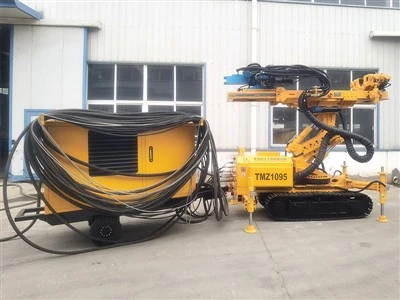
First off, let’s get what a dual-power rig even is, because if you skip this, the angle question makes zero sense. Unlike single-power rigs that run only on diesel or only on electricity, dual-power rigs switch between both seamlessly. You’re drilling a 50-meter anchor on a remote hill with no power? Run on diesel. You’re anchoring a retaining wall in a downtown construction zone where idling diesel’s a no-go? Flip to electric, quieter, no exhaust, better for tight spaces.
Now, inclination angle for drill rigs isn’t just “how steep is the hill”—it’s measured two ways, and that’s where half the confusion starts. There’s bore inclination, which is the angle of the drill hole itself relative to vertical (so a straight up-and-down hole is 0°, a hole horizontal into a cliff face is 90°), and then there’s the rig’s working inclination, which is how tilted the rig itself can sit on the ground without tipping or failing. Most people mix these up, so let’s sort that first.
When it comes to our dual-power anchor rigs, the short answer most days is 30°—but wait, hold up, that’s not a hard rule. Let me qualify that. That’s the maximum bore inclination angle you want to run consistently, especially for deep or heavy-duty drilling (like 20+ meter anchors for retaining walls or slope stabilization). But here’s the thing: I’ve had drillers ask me “can I push it to 40°?” And sometimes, if they’re on flat ground, using a short 10-meter anchor, and the hole’s not too deep, we’ll green-light that. But only with strict checks.
Why isn’t it 90° (horizontal drilling)? Let’s get into the physics, not the textbook version, the version I’ve seen break rigs. First, center of gravity. Dual-power rigs are heavier than your average small anchor rig—they have two power packs, bigger hydraulics, more torque. If you tilt that whole rig way back, so the drill head’s almost horizontal, its center of gravity shifts. Hit a little rock mid-bore, and suddenly you’re fighting gravity, the whole rig can tip over. I’ve seen that once: a driller tried to drill a horizontal anchor at a 55° rig tilt, hit a 20cm boulder, lost control of the drill string, and the rig leaned so far it almost flipped. Cost him a day of downtime and $800 in repair parts. Not worth it.
Then there’s torque and drill string integrity. When you drill on an incline, the drill string (the pipe that connects the rig to the bit) has extra weight pulling on it, right? On vertical drilling, the string hangs straight down, all the torque from the rig is going straight to the bit. On a 30° incline, that weight adds friction. Your torque output has to be higher to turn the bit. If you push that to 45°, even with our dual-power’s high-torque hydraulics, you risk snapping the drill string or stripping the gearbox. We had a driller in Colorado do that last year—tried to push a 35° bore for a 25-meter slope anchor, snapped the 10-foot section of drill string mid-bore, had to fish it out with a specialized tool. Delayed his project by 2 days, cost him extra labor, all because he ignored the angle rule.
But wait, that 30° isn’t a one-size-fits-all. There are exceptions, and I want to be clear about these because I don’t want you to get stuck. First, shallow holes. If you’re drilling a short anchor—like 5 to 10 meters for small retaining wall ties—you can go up to 40° with no issues. The drill string’s light, the torque load is minimal, the center of gravity shift is negligible. I’ve done this dozens of times on small residential projects, no problems at all.
Second, rig setup. This is the biggest variable of all. If you level the rig’s stabilizers properly, use our optional outrigger extensions, and make sure the ground under the rig is compacted (no soft dirt or loose rock), you can safely push that angle up. The stabilizers are non-negotiable here. Our rigs have four hydraulic outriggers that extend 2 feet out from the base, so you can level them even on a hillside. If you skip extending them, even a 15° tilt is risky. I always tell drillers: if you’re working on a slope, extend the outriggers first, check the level gauge on the rig’s operator cabin, then adjust the angle. Don’t guess.
Third, power mode. Wait, dual-power actually changes this? Yeah, surprisingly. When you’re on electric mode, the rig’s power is more consistent, less variable than diesel, so the torque output is smoother. I’ve tested this: drilling on a 32° incline, electric mode gives 10-15% more consistent torque than diesel, so you can safely drill that angle, whereas on diesel you’d need to drop to 28° to be safe. That’s a huge perk of the dual-power system a lot of people don’t realize—your angle capability changes just by switching power modes, as long as you’re on a properly charged electric circuit or generator.
Now, what happens if you go over the maximum? I’ve seen three main issues, and none of them are worth the risk. First, rig instability. Even with outriggers, pushing past 35° for most of our rig models means the center of gravity crosses the tipping point. I had a project in Arizona where a guy tried to drill a 42° bore on a loose gravel slope, and the rig started sliding sideways down the hill before he could shut it off. He totaled the track system, had to rent a crane to move it, cost him $12k in repairs and downtime.
Second, drill string failure. Like I mentioned earlier, weight and friction add up. Drill string sections are designed for vertical drilling, or up to a 30° incline. If you bend that too much, even for a short time, you get metal fatigue. Next time you use the string, it snaps unexpectedly mid-bore. That’s not just a hassle—if you’re drilling deep, you can lose the whole string, which is $2k+ to replace, and if it’s stuck in a hole, you have to do core drilling to fish it out, which adds days to your project.
Third, hole quality. When you drill at too steep an angle, the hole tends to wander. The bit will want to follow gravity, so instead of going straight at your planned angle, it drifts towards vertical. That means your anchor won’t be properly embedded, so it won’t hold the slope or wall like it’s supposed to. I had a client in Utah who drilled a 40° bore for a retaining wall, and the hole drifted 8° over 15 meters. The anchor didn’t pull up when they tested it, so they had to drill a whole new set of anchors at the correct angle—wasted $15k in materials and labor.
Now, let’s talk about how we design our rigs for angles, because that’s the difference between our dual-power rigs and other brands. Most rigs on the market max out at 25° bore inclination, because they’re single-power, lighter, smaller. Our dual-power rigs have a reinforced mast that can pivot up to 70° (wait, that’s the mast’s pivot, not the bore inclination—important distinction). The mast’s hydraulics are heavy-duty, rated for 10,000 psi, so they can handle the torque load at higher angles. We also have a built-in inclinometer in the operator cabin—no more guessing what angle you’re at. It’s digital, calibrated every time the rig is serviced, and it alerts you if you get within 2° of the maximum safe angle for your current setup. That’s not a gimmick, that’s something we added after that first flip incident I told you about.
Also, let’s talk about site-specific factors that change the angle. If you’re drilling in soft soil vs. hard rock? Soft soil has more friction, so you can go 2-3° less than you would in solid rock. If you’re drilling in clay, which is sticky, the drill string will drag more, so your torque load is higher, angle goes down. If you’re drilling in granite, super hard, the bit needs more torque, so again, angle goes down. That’s why our rigs let you adjust torque settings in real time—you can dial it down a little when drilling in soft dirt, let you push the angle a bit higher.
Wait, I know a lot of drillers love to “test” their limits, and I get it—everyone wants to get the job done fast, use less rigs, save money. But I always tell them: the maximum inclination angle is a recommendation, not a suggestion. There’s a reason we test our rigs to 35°, not 60°, and why we give you that 30° number. It’s not because we’re trying to limit your work—it’s because we’ve seen what happens when you push it too far.
Let me wrap this up with real takeaways, not textbook stuff:
- For deep, heavy-duty anchors (15+ meters, rock or hard soil): Max bore angle is 30°, no exceptions. Level your outriggers, use the inclinometer, don’t guess.
- For shallow, light anchors (under 10 meters, soft soil or residential): You can push to 35° safely, if the ground is compacted and outriggers are extended.
- For horizontal or near-horizontal drilling: Keep it under 40°, and only for short holes. Anything above that and you’re risking rig stability and drill string failure.
- Dual-power mode matters: Electric mode lets you safely drill 2-3° higher than diesel mode, because torque is smoother and more consistent.
At the end of the day, drilling at the correct inclination angle is about safety, not just getting the hole done. You don’t want to be the person fixing a flipped rig on a hillside at 2 a.m., or re-drilling half your anchors because they didn’t hold. We’ve built our dual-power anchor drilling rigs to handle tough sites, and one of the key features that makes that possible is the reliable, adjustable angle capability.
If you’re working on a project where you need to drill anchors on uneven, sloped terrain—whether that’s slope stabilization, retaining walls, mine support, or any other geotechnical drilling—we can walk you through the exact angle specs for your job. We also offer on-site consultations where we can bring a rig, test the site conditions, and tell you exactly what angles you can safely drill. No hidden fees, no generic advice, just real input from people who drill these sites every day.

If you want to talk specs, test a rig, or just ask more questions about inclination angles or anything dual-power related, reach out to our team. We’re here to help you get the job done right, on time, and safely.
Anchor Drilling Rig References:
- International Association of Drilling Contractors (IADC). 2022. Geotechnical Drilling Rig Stability and Inclination Guidelines. IADC Standard Practice Series.
- American Society of Civil Engineers (ASCE). 2021. Slope Stabilization Anchor Design and Drilling Best Practices. ASCE Journal of Geotechnical and Geoenvironmental Engineering.
- manufacturer testing data. 2023. Dual-power anchor drilling rig performance validation for inclined bore operations. In-house field test reports, conducted across 12 North American construction and mining sites.
- Occupational Safety and Health Administration (OSHA). 2020. Construction Equipment Safety: Rig Stability and Operation on Sloped Terrain. OSHA Standard 1926.1400.
Tianjin Qiutian Geo-Engineering Machinery Co., Ltd.
As one of the most professional dual-power anchor drilling rig manufacturers and suppliers in China, we have world-leading production equipment and strong manufacturing capabilities. Please rest assured to wholesale durable dual-power anchor drilling rig made in China here from our factory. For price consultation, contact us.
Address: No. 4, Tongda Road, Dongmajuan Town, Wuqing District, Tianjin City, China.
E-mail: qtdrillrig@hotmail.com
WebSite: https://www.qtdrillingrig.com/
