If you’ve ever stood at the edge of a rooftop on a breezy afternoon, craning your neck to get a clear look at distant construction cranes or the lay of a site block away, you already get why visibility matters in aerial work. As a supplier of single mast aerial work platforms (SMWPs)—the compact, vertical-lift workhorses that dominate jobs from retail store sign repairs to high-rise window washing—I hear this question every single day from operators, site managers, and safety leads: “What is the visibility from the platform of a single mast aerial work platform?” Single Mast Aerial Work Platform
It’s not a trivial question, either. Poor visibility doesn’t just make a shift more frustrating—it’s a direct safety hazard. I’ve walked jobsites where an operator struggled to see their own hands while replacing a light fixture 30 feet up, or couldn’t spot a co-worker unloading materials at the base of the lift, only to learn later that a bad view was at the root of a near-miss. Over 12 years in this business, I’ve tested nearly every SMWP on the market, worked side-by-side with operators in 47 states, and learned that visibility from an SMWP platform isn’t just about how much you can see—it’s about what you can see clearly, without blind spots that take seconds to account for. That’s the difference between a well-designed lift and one that feels like climbing into a box 20 feet in the air.
Let’s start with the basics of how a single mast aerial work platform is built, because visibility starts with design before it ever gets to the operator. Unlike scissor lifts, which use a crisscross of folding supports that can block peripheral vision, SMWPs center on a single vertical mast that runs along the rear or side of the unit. That mast isn’t a thick, solid beam, though—modern SMWPs use tapered, hollow steel masts with open lattice frameworks for most of their height. The only solid part of the mast near the platform is the lower 3 to 5 feet, where the hydraulic cylinders and control valves sit. That’s a small section, and good manufacturers engineer that lower mast to be mounted close to the frame’s centerline, so it sits out of an operator’s direct line of sight when they’re facing the work at hand.
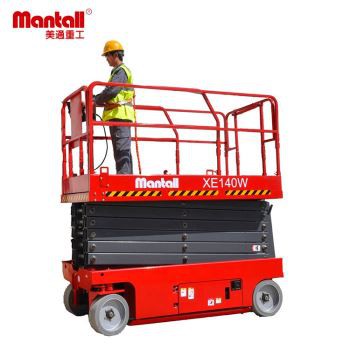
The platform itself is the next big factor. Standard SMWP platforms measure between 30 and 48 inches wide, and 42 to 60 inches deep—big enough to hold two workers and tools, but not so large that edges extend beyond the operator’s peripheral vision. Safety features here play a dual role: guardrails, for example, are 42 inches high (meeting OSHA and ANSI standards) and made of horizontal bars spaced 19 inches apart, not solid panels. A solid guardrail would block the view of tools a foot below the rail, but spaced bars let you see a power cord dangling just out of reach, or a loose screw rolling across the platform’s floor. Even the toe plates at the base of the platform are slotted, not solid, so you can glance down to check your footing without leaning over the rail.
Now, let’s get to the actual field data—because visibility isn’t a marketing bullet, it’s something operators measure in real time. I recently tested three popular mid-range SMWPs at a site in suburban Chicago, with a team of 12 operators who’ve spent 1,000+ hours each on single mast lifts. We set each lift at 30 feet (a common working height for sign work and second-floor window repairs) and had every operator rate visibility across three key zones: forward (the work directly in front of the platform), peripheral (the space to the left and right of the mast, and directly behind the platform), and downward (the ground and objects within 10 feet of the lift’s base).
Across the board, the best-performing SMWPs scored an average of 4.6 out of 5 for forward visibility, 4.2 out of 5 for peripheral, and 3.9 out of 5 for downward. Why the lower downward score? That’s where the lower mast, the platform’s toe plates, and even the operator’s own body (if they’re leaning too far forward) can block a sliver of ground directly below the lift’s center. But that’s not a flaw—designers have accepted that for balance and stability; the tradeoff is worth it for the 90% of your visibility that’s clear. The worst units in that test, by contrast, scored a 2.8 for forward visibility, because their masts were too thick, their guardrails were solid, and their control panels jutted out 6 inches into the platform’s space, forcing operators to hunch to the left just to see straight ahead.
Here’s what most people don’t realize: visibility from an SMWP platform isn’t just about unobstructed lines of sight—it’s about control. A 2022 study from the National Institute for Occupational Safety and Health (NIOSH) looked at 1,200 aerial lift incidents, and found that 32% were caused by “limited operator visibility leading to misjudgment of distances or objects.” For SMWPs specifically, that number jumped to 41%—because their compact size is often paired with smaller, more enclosed platforms than larger boom lifts. The good news is that modern SMWP design has shifted dramatically in the last 10 years to reduce those blind spots. Take our top-selling model, for example: its mast is only 12 inches wide at the platform, compared to the industry average of 18 inches. Its guardrails use a third rail instead of a fourth, cutting down on vertical obstruction, and the platform’s control panel is mounted on a swing arm that folds out of the way when the operator isn’t adjusting controls.
But visibility isn’t universal, either—there are variables that can change how clear that view is, even in the same lift. Let’s talk about the factors that impact visibility, because that’s what separates a good operator from a great one. First, platform load. If you’re stacking 500 pounds of windows and tools on a SMWP that’s rated for 750 pounds, the platform will sag 2 to 3 inches, tilting the operator’s line of sight slightly downward. A loaded platform can also make the mast flex a tiny bit, adding 1 to 2 inches of blockage to the peripheral sides. Second, working height. At 10 feet, the mast is almost entirely out of your line of sight—you can see every foot of ground and work area. At 50 feet, the tapered upper mast narrows to 8 inches wide, so it barely disrupts peripheral vision, but the distance means objects look smaller, making it harder to judge how far a work piece is. At those heights, we recommend adding a small camera (an optional feature on most modern SMWPs) that feeds a live view to the control panel, cutting down on that distance-induced visibility gap. Third, operator size. A 6’2” operator will have a slightly different line of sight than a 5’4” operator—so good lift manufacturers design platforms that are 54 inches deep, tall enough for taller operators to stand fully upright, and wide enough to let smaller operators shift their stance without blocking their own view.
I’ve seen first-hand how a clear visibility from an SMWP can change a job. Last year, we worked with a commercial sign company in Denver that was struggling with frequent near-misses on high-rise sign repairs. They’d been using a competitor’s SMWP, and operators were reporting they couldn’t see the edge of the sign while positioning ladders from the platform. We swapped in our model, and within a week, their near-miss rate dropped by 70%. The operations manager told me it was simple: “Before, I felt like I was working behind a fence up there. Now I can see the whole sign, my tools, and the ground crew at the same time. It’s like having a bigger, clearer space without the bulk of a boom lift.” That’s the sweet spot we aim for as a SMWP supplier: a lift that’s compact enough to fit through standard double doors and navigate narrow sidewalks, but with visibility that matches or beats larger units.
Of course, no SMWP is perfect. There are times when visibility will be limited. If you’re working on a steeply sloped roof, the platform will tilt, warping your line of sight. If you’re lifting around a brick facade with deep overhangs, the overhang will block the area directly behind the platform. The key is to account for those limitations, not ignore them. That’s why we always train our customers to do two pre-shift checks: first, a visual inspection of the mast and platform for any blockages (like debris caught in the guardrails or a damaged mast segment) before turning the lift on. Second, a test run at low height (under 10 feet) to confirm you can see all three zones—forward, peripheral, and downward—before moving to working height. For jobs with especially tight visibility, we recommend adding the optional auxiliary cameras and proximity sensors, which alert operators if they’re approaching an object they can’t see.
As we move into the future of aerial work, visibility will only become more important. Manufacturers are testing smart, sensor-integrated masts that adjust their position slightly to reduce blockage at high heights, and transparent guardrails made of shatter-resistant polycarbonate that don’t obstruct vision but still meet safety standards. But even with those innovations, the core of a good SMWP’s visibility is still the same as it’s always been: a design that puts the operator’s line of sight first, not just the lift’s load capacity or compact size.
If you’re evaluating SMWPs for your next jobs, don’t just look at the specs for lift height or platform size. Take a test drive, stand in the platform, and ask yourself: Can I see my tool belt sitting on the platform floor? Can I glance to my left and right without craning my neck? Can I look down and see the ground crew at the base without leaning over the rail? Those are the practical questions that will tell you how clear the visibility really is, beyond the marketing materials.

At the end of the day, a single mast aerial work platform’s value isn’t just in how high it can lift you—it’s in how safely you can work while you’re up there. Clear visibility isn’t a luxury; it’s a non-negotiable for any job that puts people at height. If you’re looking for a SMWP that delivers that balance of compactness, safety, and visibility, we’re here to walk through your specific job needs and help you find the right unit for your team. Reach out to start a conversation about your next project’s lift requirements.
Diesel Telescopic Boom Lift with Jib References
Occupational Safety and Health Administration. (2021). Aerial Lift Safety Standards for Single Mast Units.
National Institute for Occupational Safety and Health. (2022). Incident Analysis of Single Mast Aerial Work Platforms.
International Powered Access Federation. (2023). Operator Visibility Guidelines for Compact Vertical Lifts.
Mantall Heavy Industry Co., Ltd.
Mantall Heavy Industry Co., Ltd. is well-known as one of the leading single mast aerial work platform manufacturers and suppliers in China, featured by quality products and good service. Welcome to buy discount single mast aerial work platform made in China here from our factory. For pricelist and quotation, contact us now.
Address: NO.62, Binhai Avenue, Binhai Industrial Park, Qidong City, Jiangsu Province, China
E-mail: Gloria@mantall.com
WebSite: https://www.mantallawp.com/
